
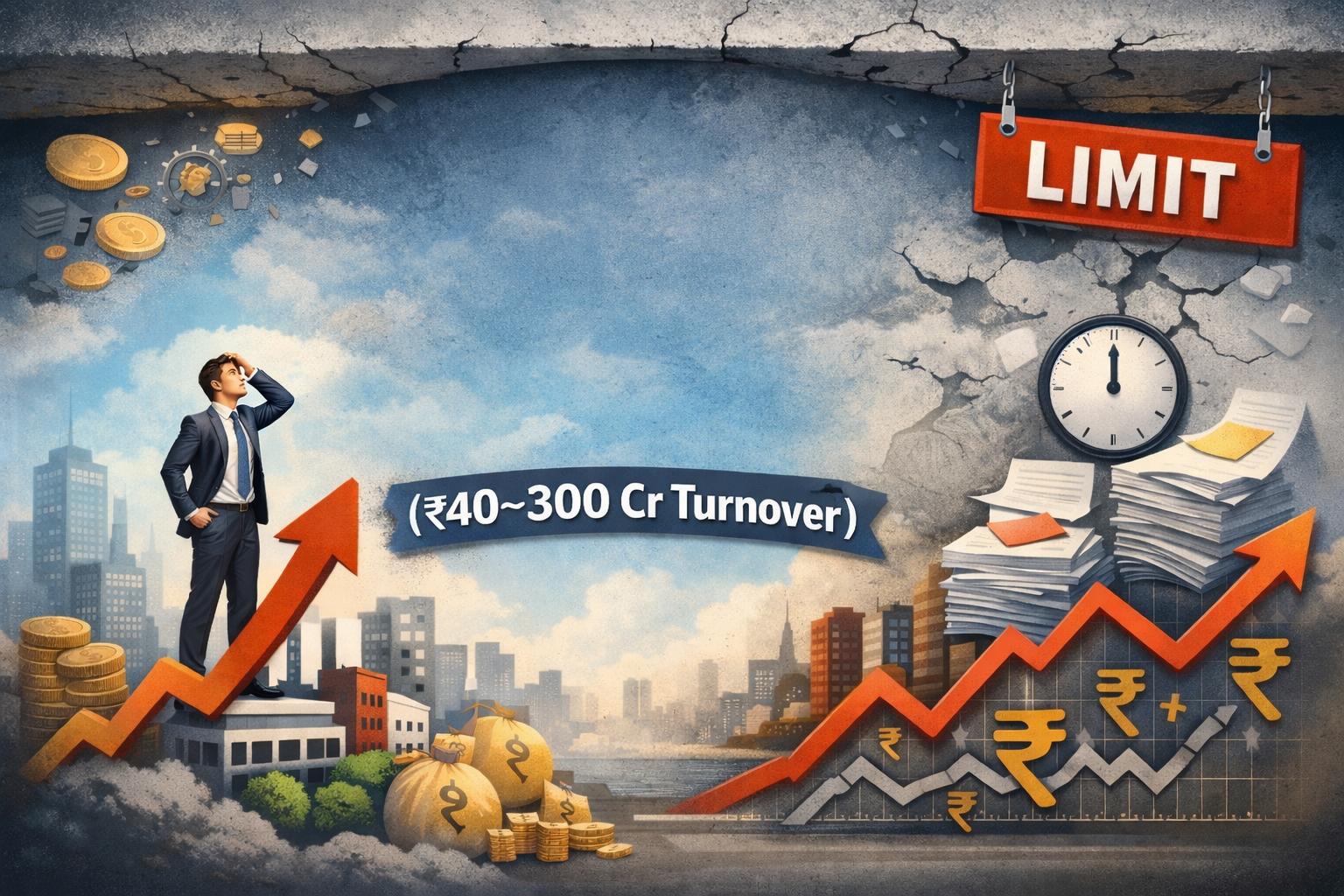

There is a strange phase in many businesses that fall in the ₹40 Cr to ₹300 Cr annual turnover range. From outside, everything looks fine. Revenue is steady. The brand is known. The company has survived market cycles.
But inside, the business feels stuck. Growth has slowed. Margins are under pressure. Competition feels stronger. And somewhere deep down, the owner feels that the business has reached a saturation point.
Having worked closely with several such organizations, I have seen this pattern repeat again and again. This is not theory. This is real life.
So why does this happen?
Stage One: Success Beyond What Was Ever Dreamt
In most such cases, the business is still run by the first-generation founder, who has full control. He started like any normal person—with simple dreams:
- A decent income
- Independence
- A small team
- A stable life
The business was never planned to become big. But due to a niche product, a market gap, or perfect timing, the response from the market was far better than expected. Sometimes, much more than what he had ever imagined—or even dreamt of.
This unexpected success slowly changes the mindset.
The owner starts believing:
- “My product is the best”
- “My way of working is right”
- “If this worked earlier, it will keep working”
And honestly, for many years, it does.
Stage Two: Comfort Grows While the Market Changes
The first decade or so usually goes well after the initial struggle. Cash flow stabilizes. Customers trust the brand. Life becomes comfortable.
Now the thought of expansion comes in.
But here’s the catch:
While the heart wants growth, the mind has learned comfort.
During this time, the market changes fast:
- Small local players become aggressive
- Regional and national players enter
- MNCs step in with money, branding, and systems
- Customer expectations change
- Technology reshapes everything
But investments in:
- Sales teams
- Distribution networks
- New geographies
- Marketing
- Skill development
- Technology
are mostly avoided. The old mindset sees these as risks, not necessities. The market, people, and even geopolitics have changed—but the business mindset hasn’t.
Stage Three: The Daily Fight Between Heart and Mind
This is the most painful stage.
The owner genuinely wants growth. But the mind keeps saying:
- “Why take risk now?”
- “What you have today is more than enough”
- “You never even dreamt of reaching here”
Unknowingly, this creates satisfaction with stagnation. The comfort zone starts looking safer than growth. The business doesn’t fall—but it also doesn’t rise.
Stage Four: Conditional Permission to Grow
After years of this internal struggle, one day the owner finally decides to take a step forward.
But the mind doesn’t give free permission.
It comes with conditions:
- Limited investment
- Limited authority
- Short timelines
- Immediate results
- No room for mistakes
Deep down, the mind already knows that growth won’t come under these conditions. But it agrees just enough to silence the heart.
Stage Five: Hiring Hope, Not Empowerment
Now begins the search for someone who can deliver growth.
A professional is hired. Initially, the heart—having won the recent battle—gives full support and freedom. The baton is handed over.
But the foundation is weak. Expectations are high. Support systems are missing.
Stage Six: The Old Team Pushes Back
The new person takes charge. But the resistance doesn’t come only from the owner—it comes from the old team.
This is human nature.
People who grew with the company:
- Are comfortable
- Fear losing control
- Feel threatened
- Resist change
Slowly, office politics start. Lobbying happens. Gossip spreads. Not always intentionally—but enough to weaken the plan.
Stage Seven: Mind Finds Proof
Information reaches the owner—but in a twisted form.
The mind, which was against the plan from day one, finds confirmation:
- “This won’t work”
- “Markets are bad”
- “The person is not right”
Market changes take time. Growth needs patience. But impatience, conservative investments, fear of new technology, and daily expectations of miracles kill the environment.
Daily reviews turn into arguments. Discussions turn into blame games.
The mind keeps whispering:
“It was right to say no to change.”
Stage Eight: Retreat and Ego Protection
Finally, the mind wins completely.
The expansion plan is dropped. The business returns to its comfort zone. The blame is placed on:
- The new hire
- Market conditions
- External factors
This protects the owner’s ego:
“I tried my best. People are not right. No one can run this business better than me.”
This story has played out in hundreds of medium-scale companies—trying to grow once or twice in their lifetime and failing at the same point.
Conclusion: The Real Make-or-Break Moment
In the battle between mind and heart, the mind usually wins—because it produces logic, numbers, and short-term facts.
But the heart carries something else:
gut feel, instinct, vision, and long-term truth.
Heart needs time to prove itself. Mind rarely gives that time.
Yet history shows us something powerful:
Many brands that came back from their darkest phases did so because founders trusted their instinct, backed leadership, crushed politics, invested patiently, and refused to let comfort hijack growth.
If you’ve read this and felt, “This sounds familiar”—you’re not alone.
Have you gone through this phase?
Do share your views.
And if you need support navigating this journey—we’re happy to help.
Move Forward with Direction, Awareness and Confidence
Subscribe to our blog
Get notified about new posts