
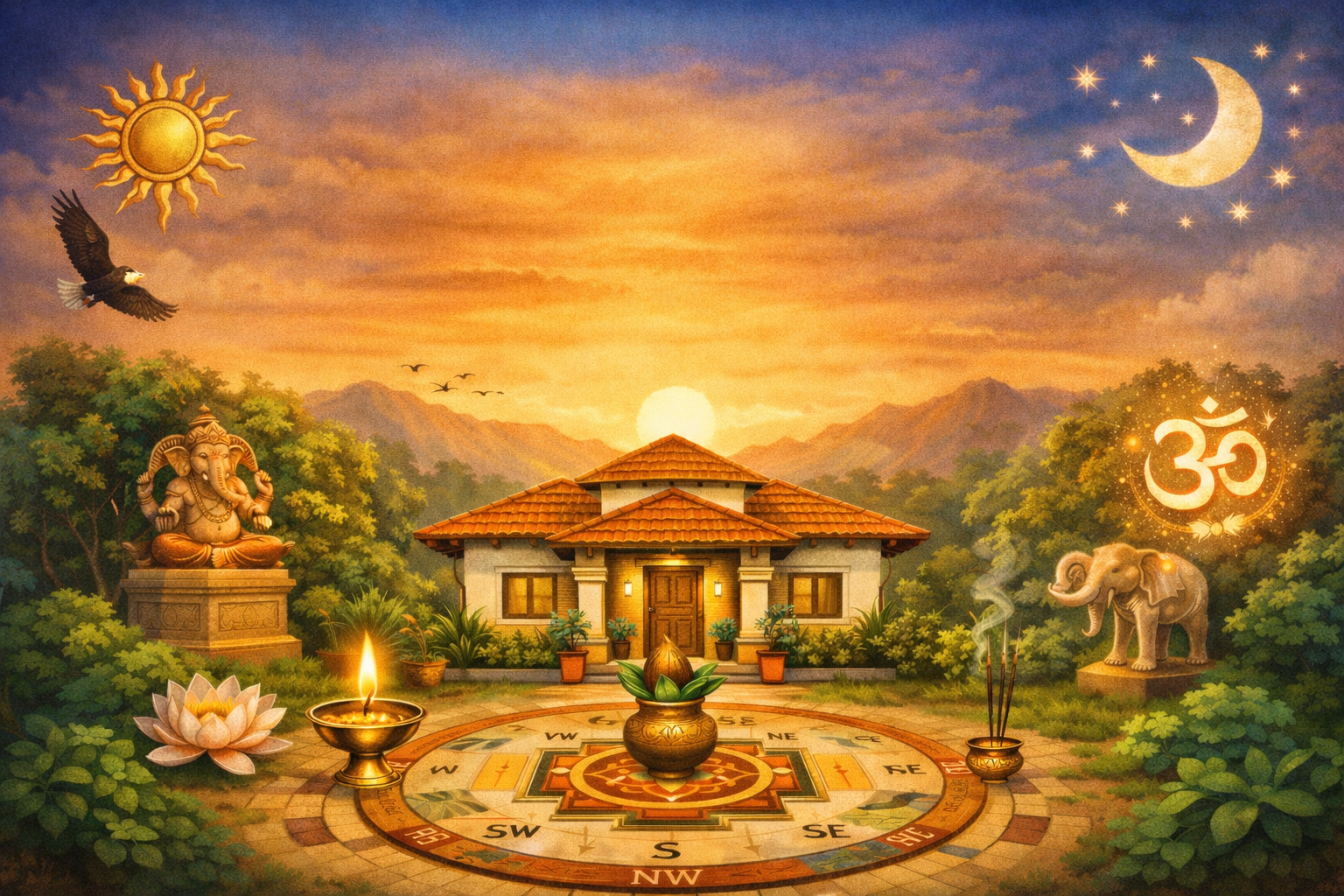

In today’s fast-moving world, people invest heavily in good homes, premium interiors, luxury furniture, and smart technology. Yet, many continue to experience unexplained stress, health issues, financial instability, or disturbed relationships. When everything looks right but life still feels blocked, the missing link is often Vastu.
Why Vastu?
Vastu is not superstition, belief, or blind faith.
It is an ancient Vedic science of space, energy, and direction, developed thousands of years ago to align human life with the natural forces of the universe.
Just as gravity affects us whether we believe in it or not, directional energies impact us continuously. Vastu simply helps us live in harmony with these forces, instead of unknowingly fighting them.
Your home is not just a physical structure—it is an energy system. Every wall, corner, direction, and element (Tatva) influences your thoughts, emotions, health, and outcomes in life.
Significance of Vastu in Daily Life
A Vastu-aligned home supports:
- Mental peace and emotional stability
- Better health and sleep
- Financial growth and savings
- Harmonious family relationships
- Faster recovery from stress and setbacks
On the other hand, Vastu defects (Doshas) do not create instant disasters—but they silently drain energy over time, leading to repeated struggles, delays, and exhaustion.
Impact of Right and Wrong Directions
Each direction is governed by a specific planet and natural energy:
- East (Sun) – Health, confidence, clarity
- North (Mercury) – Wealth, opportunities, cash flow
- South (Mars) – Stability, strength, discipline
- West (Saturn) – Patience, long-term growth
When rooms are placed correctly, energies support you naturally.
When placed incorrectly, the same energies start working against you.
For example:
- A bedroom in the wrong direction can cause anxiety, disturbed sleep, or relationship issues
- A kitchen in the wrong zone may impact health and finances
- A wrongly placed pooja mandir can reduce mental peace instead of enhancing it
Role of Tatvas (Five Elements) in Vastu
Vastu is deeply rooted in the balance of Pancha Tatva:
- Earth (Prithvi) – Stability, grounding
- Water (Jal) – Flow, emotions, finances
- Fire (Agni) – Energy, digestion, action
- Air (Vayu) – Thoughts, movement
- Space (Akash) – Expansion, opportunities
Wrong placement of these elements disturbs internal balance.
For example, excessive fire energy in sleeping zones increases anger and restlessness, while wrong water placement affects cash flow and emotional stability.
Vastu Is Science, Not Superstition
Vastu is governed by:
- Earth’s magnetic field
- Solar movement
- Geometric energy grids
- Planetary directional forces
Modern architecture focuses on structure and aesthetics.
Vastu focuses on how that structure interacts with natural energy.
When science of construction and science of energy work together, results multiply.
Free Vastu Guide: Pooja Mandir Placement
Pooja Mandir Vastu
✔ Best direction: North-East (Ishanya)
✔ Face East or North while praying
✔ Keep the area clean, light, and uncluttered
✘ Avoid mandir in bedroom, under staircase, or near toilets
Right placement enhances mental clarity, faith, and inner stability.
Final Thought
Your home silently works 24×7 for or against you.
When Vastu is aligned, life flows with less resistance—health improves, finances stabilize, and decisions become clearer.
Vastu does not replace effort.
It amplifies results by removing unseen blocks.
Think of it as tuning an instrument—
When tuned correctly, even gentle effort creates powerful music.
If you’re building, buying, renovating, or already living in a space that feels “off,” a Vastu consultation can become a turning point, not an expense.
Because when your space supports you,
life stops feeling like a struggle and starts feeling like progress.
Move Forward with Direction, Awareness and Confidence
Subscribe to our blog
Get notified about new posts